




 “The Story Behind This Movie is Crazy!”
Once upon a time in North Korea there was this dictator, Kim Jong Il, mostly known for being the blueprint archetype for the evil final boss in a Far Cry game. Big boss Kim was also a huge movie buff, a true cinemaphile who owned up to 20,000 films. Rambo, Raiders of the Lost Arc, Friday the 13th, and, of course, kaiju movies like Godzilla, were some of his favorite films. But when it came to North Korean films, there wasn’t much to be impressed by, as they all were mostly boring duds made for propaganda.
Then there was this famous South Korean film director, Sang-ok Shin, “The Prince of Korean Films“ as he was called. And Kim had an eye for him. This was his Steven Spielberg, so to speak. So, in order to produce some more profitable movies in North Korea, big boss Kim took the easy way to get Shin kidnapped to be hold in “house arrest” (just to put it nicely) in North Korea where he was forced to make movies. Plain and simple. This was between 1978 and 1986 after he managed to escape to the US.
If this alone sounds totally bananas, this is just the tip of the iceberg of this absurd saga. So, here’s a complicated story, which could have been an insane movie by itself, cut simple: it all started with a kidnapping in Hong Kong, not by Shin, but by the actress Choi Eun-Hee. The year was 1978 and the actress was the ex-wife of Sang-ok Shin and the favorite actress of big boss Kim. When Shin flew to Hong Kong to search for her, he got assaulted by some agents under the orders of, guess who, the big boss Kim, who brought him back to Mordor, I mean North Korea. The cinemaphile that Kim was, opened a brand new movie studio with 700 employees/slaves where Shin was forced to make films. Several starred his ex-wife. Yes, she was alive. The films weren’t seen by anyone, maybe expect for some few lucky people in the country that were actually allowed to. Most people didn’t even knew what a movie theater was. And that didn’t put any cash in Kim’s pockets. Showbiz is tough, even in North Korea. What a shocker. So now what?
Then 1984 came with The Return of Godzilla, which became a smash success in Japan. Big boss Kim saw the movie and said to Shin while sitting with his high heels and eating chocolate pudding: I also want one! Now! Alright, then. Here’s Pulgasari for you, an absurd, goofy Godzilla-clone ordered straight from Temu (even before Temu). Happy now, big boss Kim? Can I and my ex-wife go home now? Please? This was a big international co-production with China and Japan and was meant to be the big magnum opus for North Korean cinema. Toho Studio was actually involved here. Yes, in Mordor, I mean North Korea. Must have been some blackmailing going on here, ’cause that the film was made and finished under its bat-shit crazy circumstances is a miracle by itself.
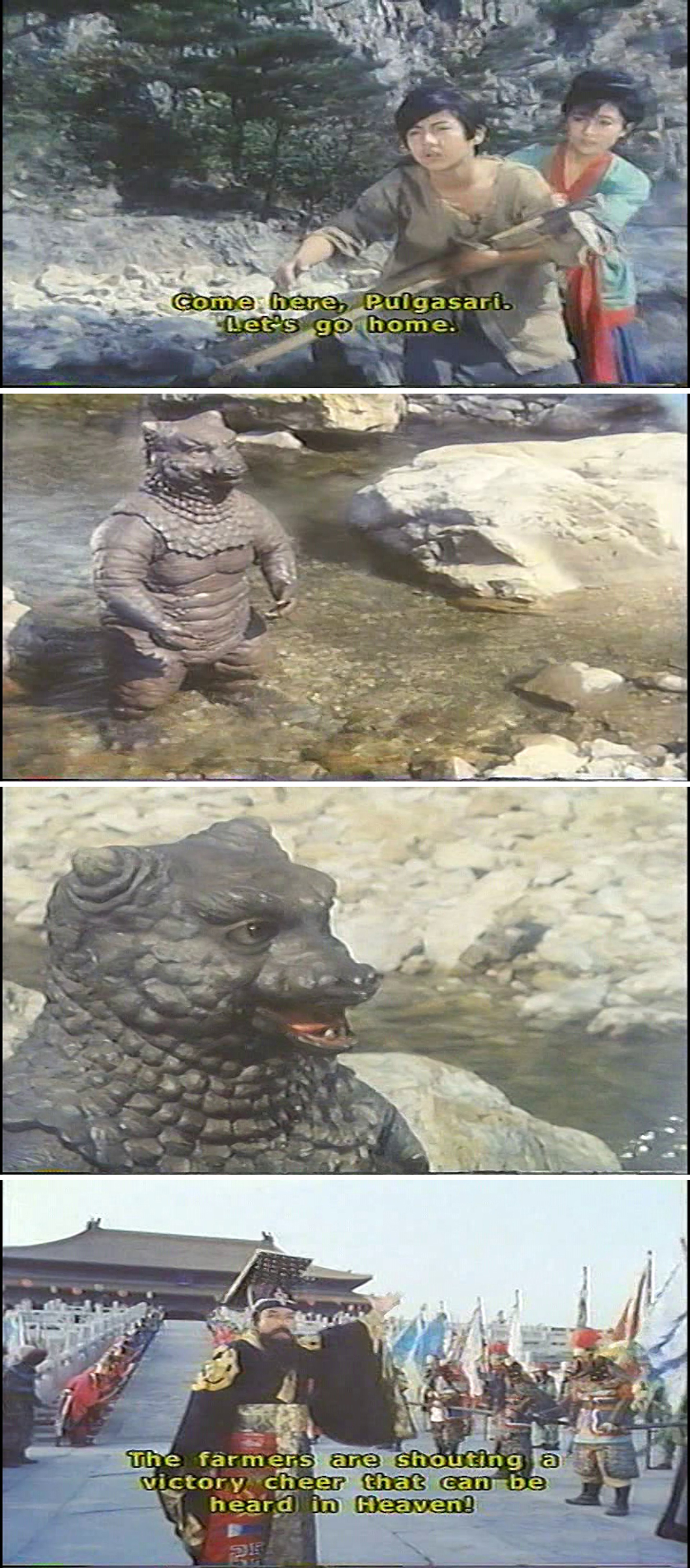
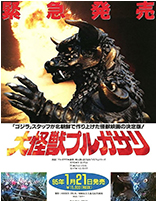
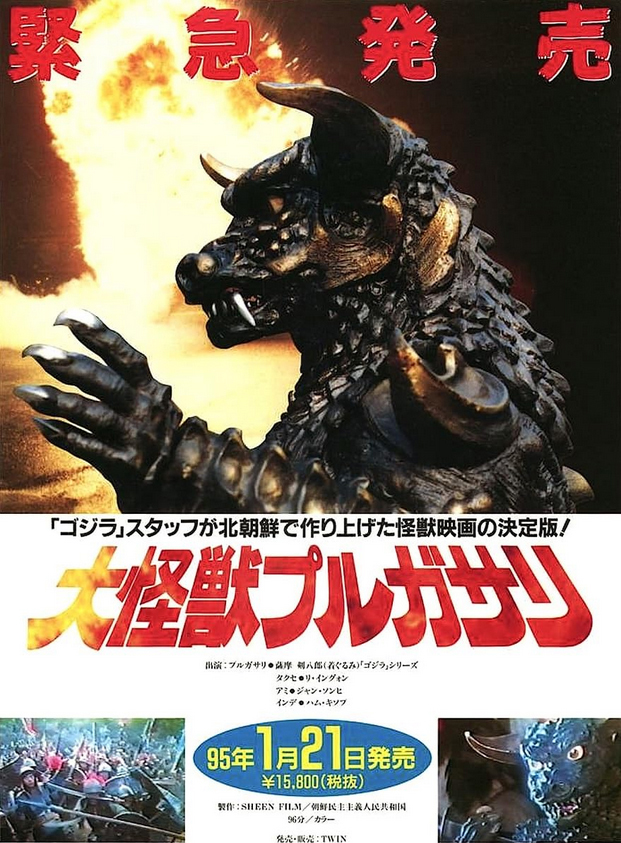
The plot for Pulgasari goes like this: We’re somewhere in the 1300s North Korea where the peasants and farm people are living under tyranny by an evil king. No shit. The time period could as well be set in 1985, even in the present day of 2026, and there wouldn’t be much difference. The evil king forces a small village to hand over all of their metal so he can make weapons. As the blacksmith, Takse, refuses to forge the weapons for the king, he gets shoved into a muddy prison cage to die of starvation. His daughter Ami tosses some rise into his cage, and here it’s when it gets interesting: instead of eating the rise, he mixes it with mud and makes a kaiju action figure out of it. After Takse dies, his daughter takes the figure, sticks a needle in her finger and drops her blood on it, and it then comes to life. She names it Pulgasari. And Pulgasari is a sight to behold. The creature grows from a cute n’ cuddly goofy-looking puppet, to Bowser from Super Mario Bros, just without the shell, and the red hair.
Pulgasari’s favorite food is metal. And the more he eats, the bigger he gets. The peasants now have a perfect weapon to fight against the evil king and his empire. And the most ironic thing here is that this is actually an uplifting story about fighting against tyranny — in the forbidden country of North Korea, while at the same time being produced by a tyrant. Bruh… Ami, who basically gave birth to the monster, also gets held hostage by the king, which gives Pulgasari a bigger motivation to destroy the evil empire.
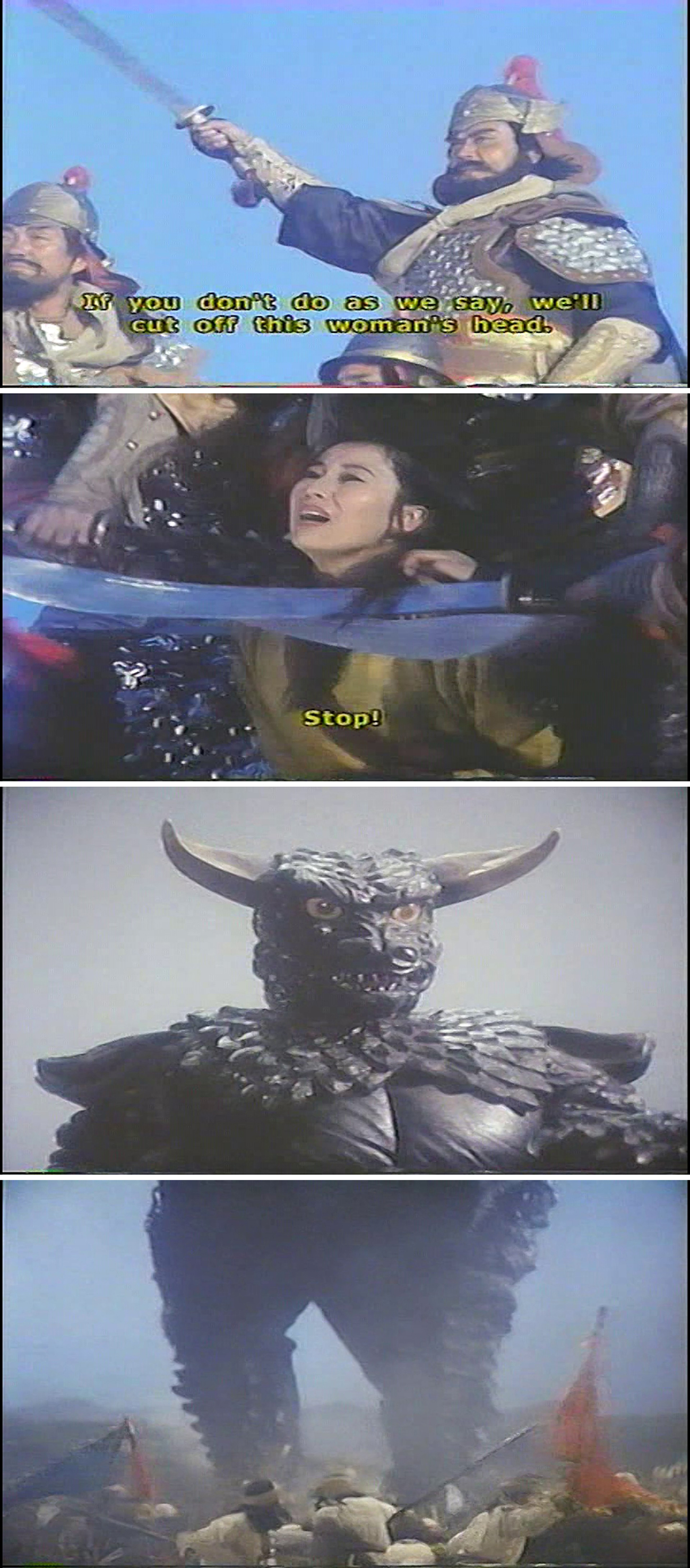
So what we basically have is a messy, clunky, chaotic and tone-deaf circus show with lots of crazy things going on, where I’d also guess that the safety standards were nonexistent. Around 10,000 soldiers were used as extras here who risked their lives as they got attacked by dozens of rolling fireballs. 3.5 million people in North Korea died of starvation a few years after big boss Kim produced his masterpiece, so I would assume that he is just maybe the kind of guy who couldn’t give a fuck less if some actors got seriously hurt or killed during the filming. Roll camera, hope for the best and rest in piece in advance, just in case.
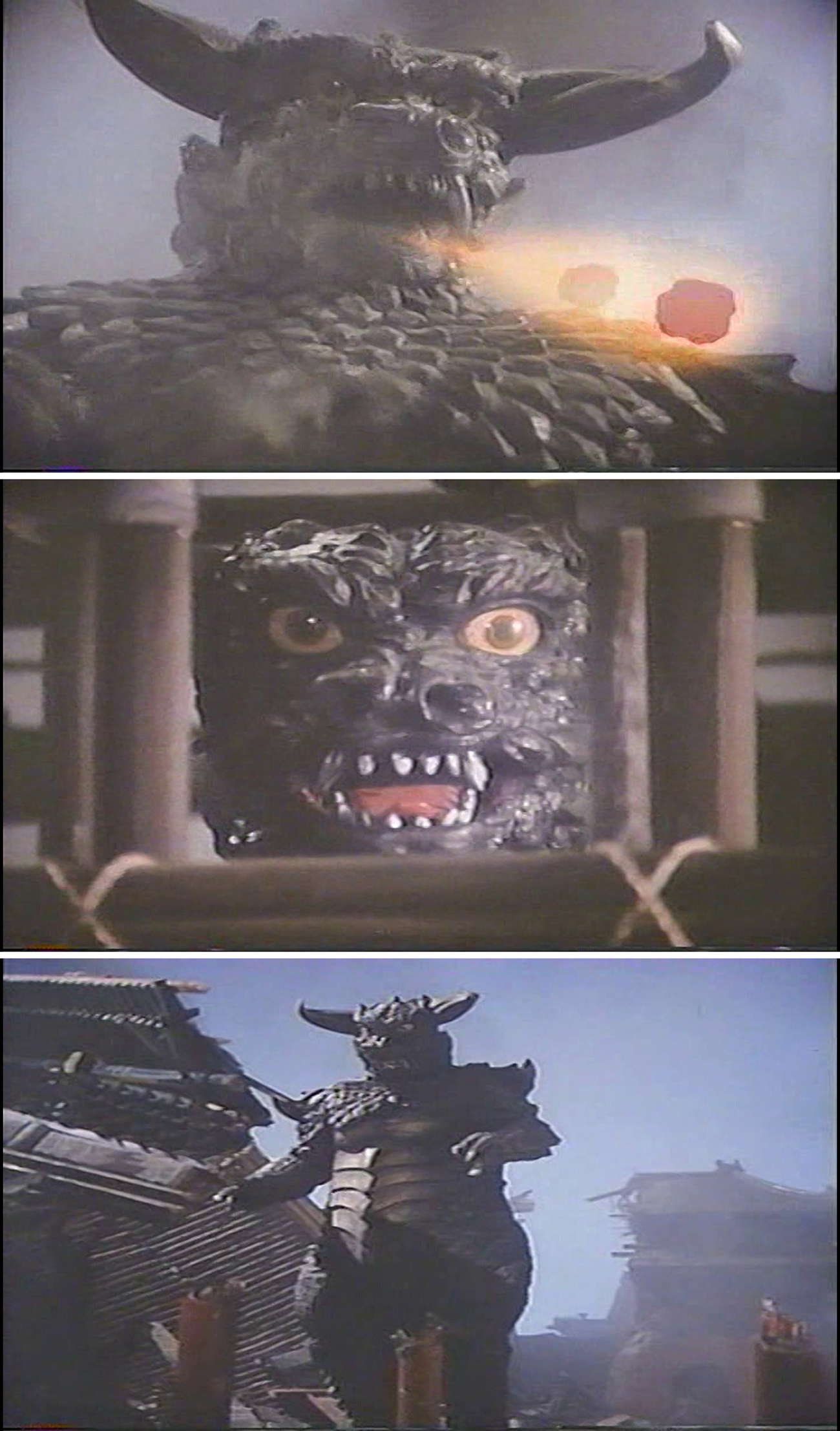
The film isn’t completely hopeless though. The Japanese company Toho was as mentioned involved, which also made the rubber costume of Pulgasari. Inside the costume was Kenpachirô Satsuma, a veteran known for being Godzilla in a laundry list of movies. Pulgasari has lots of screentime where he spits fireballs and destroys miniature buildings. The classic stuff. And if you expect the film to land on a more conventional ending, well — SPOILER WARNING — After Pulgasari saves Ami and wipes off the tyranny, they don’t know what to do with him. He doesn’t get any smaller, and metal is his only food. So… looks like someone just has to euthanize the poor thing before he becomes a serious new threat. The solution? Ami hides in a bell where she waits for Pulgasari to eat her. After doing so, he have the oh shit, what did I just do?-look on his face before quickly imploding and falling apart into dust. But there is actually one more little special and magical moment after that which I won’t spoil.
The aftermath of the whole epic spectacle is a chapter in itself, but there is actually a positive ending here. Shin Sang-ok and his ex-wife got remarried after a suggestion from big boss Kim himself. Then came the time to sell Pulgasari to the world. Yes, outside of North Korea. And during a film festival in Vienna, Shin and his wife finally managed to escape and seek asylum in the US where he made some low-budget ninja films under the pseudonym of Simon S. Sheen. In 1996, he was the executive producer on Galgameth, an American fantasy film for kids, based on Pulgasari. Big boss Kim, on the other hand, was pissed. So pissed that he buried all of Shin’s movies, including Pulgasari, even though he called it a masterpiece. However, the film somehow survived, and in 1996 it was put on the silver screen for the first time in Tokyo, where it was a success that even outperformed the American remake of Godzilla (1998). Pulgasari wasn’t as lucky in South Korea where it sold under 10,000 tickets. Some other sources say that Kim Junior, the son of big boss Kim, is a big fan of of the film and tried to sell the film internationally himself at one time, which went nowhere.
And all that said, it comes at no surprise that there’s no official release of the film. The only thing to grab it on are DVD-bootlegs. It’s not exactly in HD, but still looks better than the AI filter version that’s available on YouTube.
Director: Shin Sang-ok
Writer: Se Ryun Kim
Country & year: North Korea/Japan/China, 1985
Actors: Son Hui Chang, Ham Gi Sop, Jong-uk Ri, Gwon Ri, Gyong-ae Yu, Hye-chol Ro, Sang-hun Tae, Gi-chon Kim, In-chol Ri and about 10.000 of involuntary extras
IMDb: https://www.imdb.com/title/tt0089851/