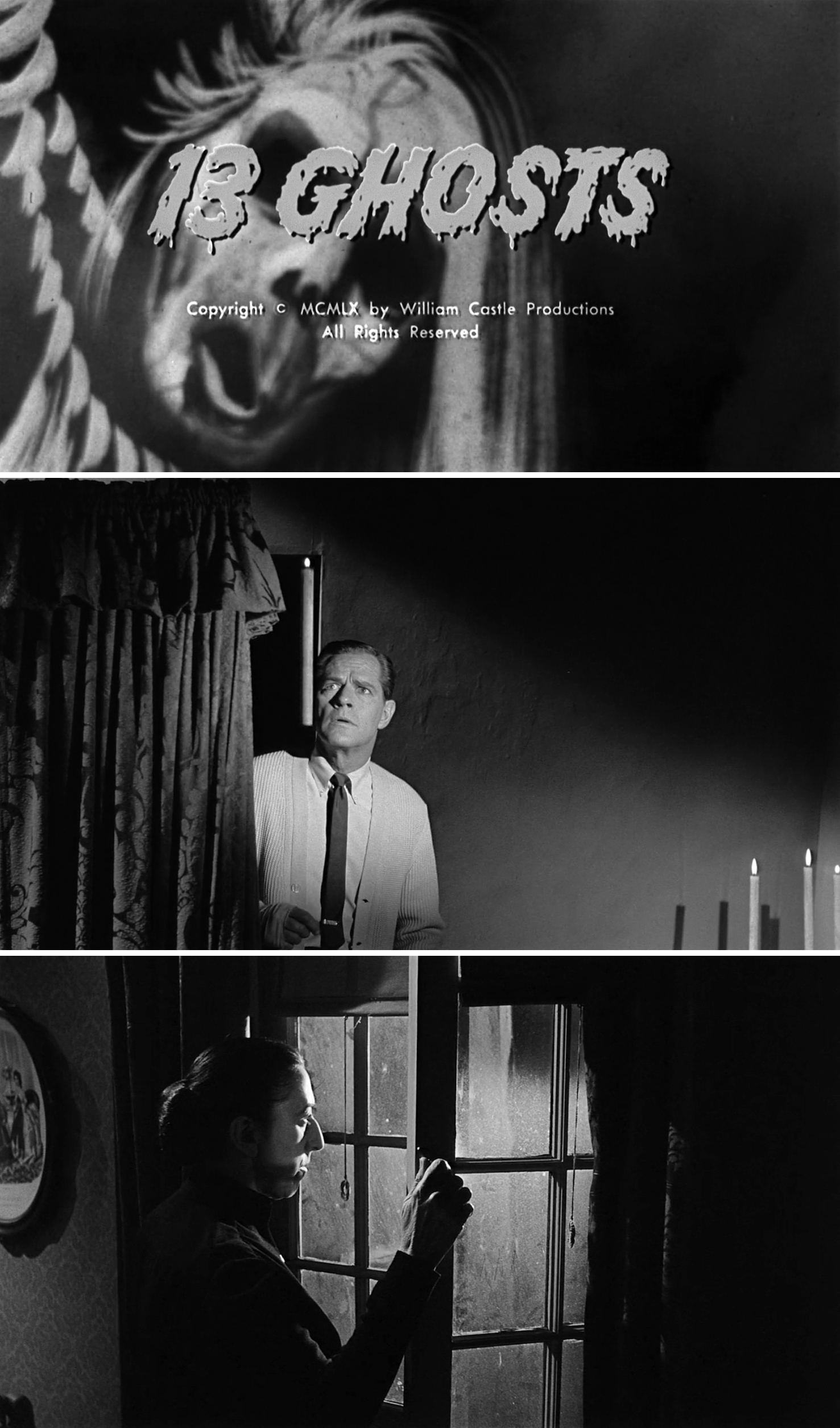
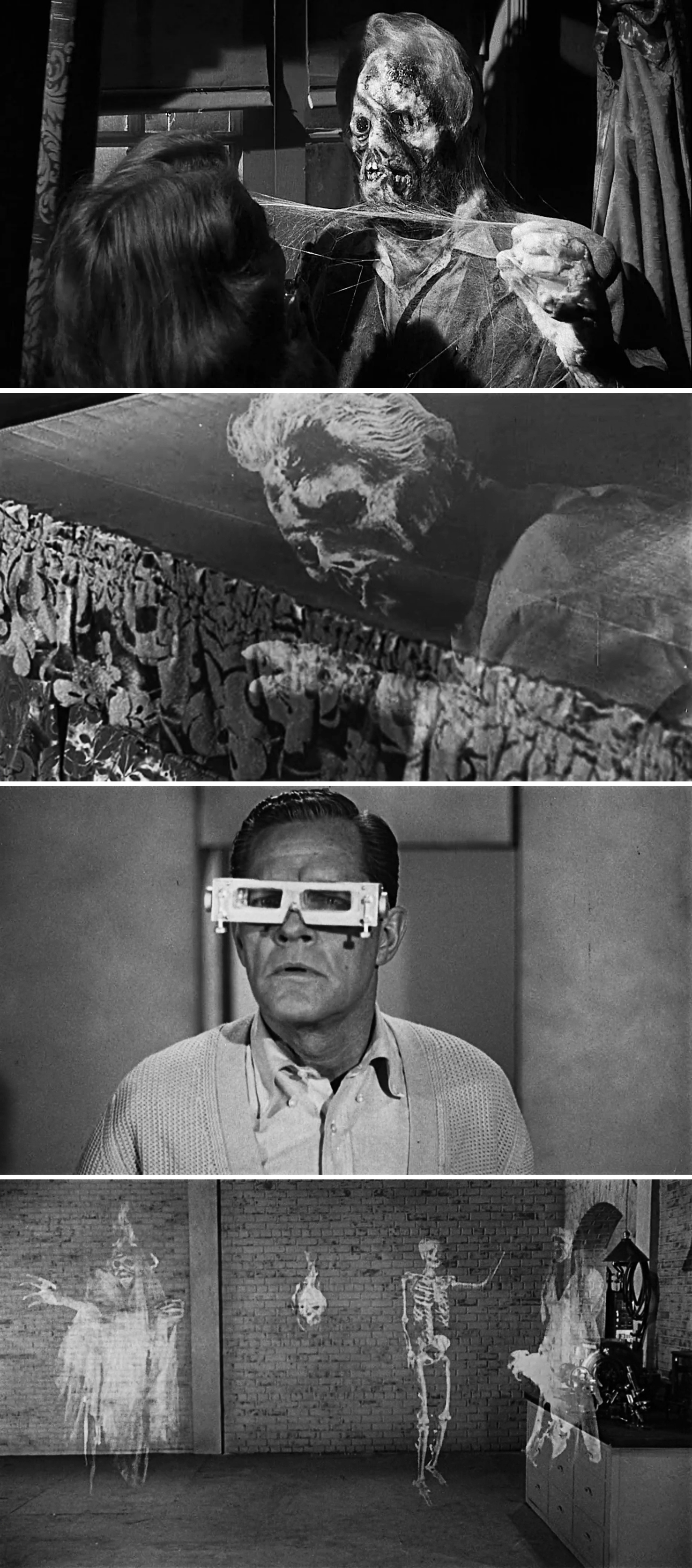
The late Dr. Plato Zorba is an occultist who has left his large house to his nephew Cyrus. Curys and his family are living very much from hand to mouth, struggling with making ends meet, so this is a wonderful opportunity for them. Or so they think. Curys, along with his wife Hilda and their daughter Medea and son Buck, decide to move to the house despite the lawyer informing them that the house is also inhabited by a bunch of ghosts that Dr. Zorba collected from all around the world. With the property also comes a housekeeper named Elaine, who of course conducts seances and is creepy as hell. And that’s not even all, as there is a hidden fortune somewhere on the property. The ghosts are a varied sort, including a fiery skeleton, a slightly goofy Italian chef, and even a lion with its headless tamer. And none of them are there willingly, as they’ve been captured by Dr. Zorba who also created a set of special goggles that makes you able to see the ghosts. There are 12 ghosts in the house, one being the ghost of Dr. Zorba himself who is also trapped and wants someone to become the unlucky 13th ghost to free him and the others.
13 Ghosts is a supernatural horror film from 1960, written by Robb White and produced and directed by William Castle. In some previous films, William Castle had used gimmicks to promote them, and 13 Ghosts was no exception. Audience members were given the chance to see the ghosts by using glasses with red and blue cellophane filters, in a process dubbed “Illusion-O“. The filmed elements had a blue filter, while the ghosts had a red filter, so the blue filter “removed“ the ghosts. Using the glasses gave the viewers the option to see them.
The movie, and mostly the gimmick, was not all that well received, but it still became a modest box office success. It’s a fun old-fashioned haunted house film that of course never manages to scare, but still has its charm. The ghosts are actually interesting enough, all with their own little backstories and looks. I especially liked the ghost of the lion and headless tamer…makes me wonder why this was counted as just one ghost, though, as the lion and the tamer are definitely two ghosts. There’s another two-for-one deal here: the ghosts of a mother and her infant son who were both burnt at the stake as witches. Aside from the ghosts who are more or less “just there“, the story is simple and straight-forward enough with some mysteries and plot twists. After all, it isn’t only in Beetlejuice that you should never trust the living. Even with a house full of ghosts, the ones still breathing are a bigger threat than the dead ones.
13 Ghosts is very much a classic haunted house film, with some solid special effects for the time it was made in.
Director: William Castle Writer: Robb White Country & year: USA, 1960 Actors: Charles Herbert, Jo Morrow, Martin Milner, Rosemary DeCamp, Donald Woods, Margaret Hamilton, John van Dreelen IMDb:https://www.imdb.com/title/tt0053559/
Outside of Paris, a woman is driving with a mysterious passenger in the backseat. When she stops near the river, we see that the mysterious passenger is actually a dead person whom the woman dumps there. Later, when the body has been found, it is believed to be Christiane, the missing daughter of Dr. Génessier. He is called in to identify the body, and claims that it is indeed his daughter. Which is nothing but a big, fat lie, as his daughter is very much alive and lives in isolation at his mansion which also lies next to his private clinic. She is always wearing a face-like mask, as she was severely disfigured after a car crash which was her father’s fault. Dr. Génessier is mainly driven by guilt as the reason for trying to restore his daughter’s face by removing the skin from other young women, hoping to graft it into her face. It has always been a failure, though, and the woman dumped in the river was his latest victim which was disposed of by his faithful assistant Louise. Louise must now find a new victim for the next experiment, and ends up choosing a young woman named Edna Grüber, who is lured to the mansion under the offer of a cheap room for rent. Maybe the experiment will be successful this time…
Eyes Without a Face (French title: Les yeux sans visage) is a French horror film from 1960, directed by Georges Franju. It is based on a 1959 novel by Jean Redond, and he also co-wrote the screenplay. It was also a co-production between France (Champs-Élysées Productions) and Italy (Lux Films). It was shot in Paris and the suburbs surrounding the city, and some scenes were shot at Boulogne Studios. When making it, the censors were a big concern, so they tried to tone it down in the ways possible to appease everyone: not including a lot of blood which would have upset the French censors, not showing animal torture which would have made the English censors throw a hissy fit, and leave out any typical “mad scientist“ elements which apparently would have pissed off the German censors. And it passed through the European censors and premiered in Paris on 2nd March 1960, but it still caused quite a stir. People really reacted at that heterografting scene where a woman gets the skin of her face removed, and when the film was showed at the 1960 Edinburgh Film Festival, seven audience members fainted to which the director simply responded “Now I know why Scotsmen wear skirts“…
In the US, the movie was edited, dubbed, and renamed into The Horror Chamber of Dr. Faustus and released in 1962. Parts of the heterografting scene was removed amongst several other scenes, and had a very limited run and little attention. Eyes Without a Face was not received well upon its release, but is today considered one of the most influential horror films of all time. John Carpenter has also mentioned that the featureless mask of Michael Myers was inspired by the film.
It is kind of a slow one, but without a doubt very atmospheric, much enhanced by the moody black and white shots. Christiane’s mask is perfectly eerie in its lifelessness, and there is a gradual buildup of mystery over how her face actually looks as she’s either wearing the mask, or having her face turned away from the viewer. Her father, while not coming off as too “mad doctor“-ish, still pulls off a character without any scruples when it comes to restoring his daughter’s face. Instead of having the typical madman who is obsessed because of some scientific experiment just for the sake of ego and science, we have a man who does everything out of guilt, inadvertently doing even more horrible things than the one he’s trying to correct. The characters here aren’t really villains, just tragic people.
Like mentioned the movie is mostly moody and atmospheric, but the tone of the film sometimes becomes really strange when it’s often playing a carnival-esque waltz (Générique) as the soundtrack for multiple scenes. It’s used over and over, in all kinds of scenes, and actually gave me a little bit of a chuckle at times…but the eerie carnival waltz works well when imagining the downward spiral of madness awaiting Christiane. And, speaking of: while you do of course feel sorry for Christiane and what happened to her, it becomes a bit irksome how she spends every breathing moment feeling sorry for herself. Yes, we’re supposed to feel a great bit of sympathy for her and the situation she’s in, but she’s living in a friggin’ mansion, having everything she needs. It’s not like she doesn’t have at least a chance of trying to cope with her life in the way it turned out. She could’ve learned a thing or two from Sal Fisher in that department. Also, her character does lose a bit of sympathy from me since it becomes obvious early on that she knows what her father is doing, which the desire for a new face isn’t going to justify. Sure, she’s getting some kind of redemption arc when the guilt gets the best of her…but still…
Of course, one of the highlights of the film is that scene, the one that made people faint and the US version getting a cut. I’m of course talking about the face removal scene. And yeah, of course it isn’t nearly as graphic as what you can see in some movies these days, but I really understand why some people found it to be a tough watch back in 1960. It’s probably much to do with the black and white, and it looks for the most part quite realistic. Maybe a small, early foretaste of the French Extremity films that were to come much later.
Overall, Eyes Without a Face is an interesting film to watch, where it’s easy to see how it would influence a lot of creative minds later on. Well worth a watch!
Director: Georges Franju Writers: Pierre Boileau, Thomas Narcejac, Jean Redon, Claude Sautet, Pierre Gascar Original title: Les yeux sans visage Country & year: France/Italy, 1960 Actors: Pierre Brasseur, Alida Valli, Juliette Mayniel, Alexandre Rignault, Béatrice Altariba, Charles Blavette, Edith Scob, Claude Brasseur, Michel Etcheverry IMDb:www.imdb.com/title/tt0053459/

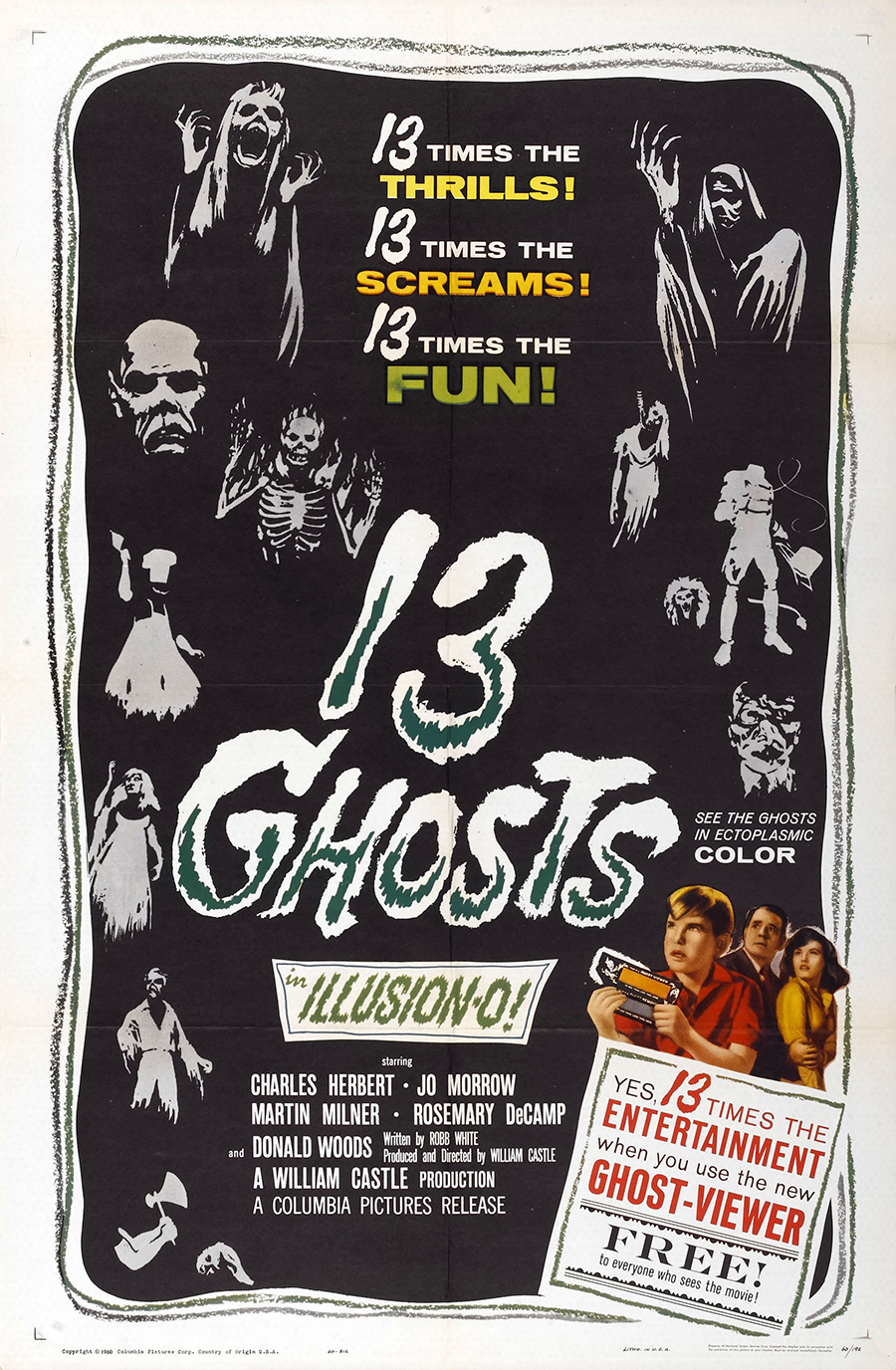 The late Dr. Plato Zorba is an occultist who has left his large house to his nephew Cyrus. Curys and his family are living very much from hand to mouth, struggling with making ends meet, so this is a wonderful opportunity for them. Or so they think. Curys, along with his wife Hilda and their daughter Medea and son Buck, decide to move to the house despite the lawyer informing them that the house is also inhabited by a bunch of ghosts that Dr. Zorba collected from all around the world. With the property also comes a housekeeper named Elaine, who of course conducts seances and is creepy as hell. And that’s not even all, as there is a hidden fortune somewhere on the property. The ghosts are a varied sort, including a fiery skeleton, a slightly goofy Italian chef, and even a lion with its headless tamer. And none of them are there willingly, as they’ve been captured by Dr. Zorba who also created a set of special goggles that makes you able to see the ghosts. There are 12 ghosts in the house, one being the ghost of Dr. Zorba himself who is also trapped and wants someone to become the unlucky 13th ghost to free him and the others.